

Remember and Be Human Again
Escaping the blurry sea of now

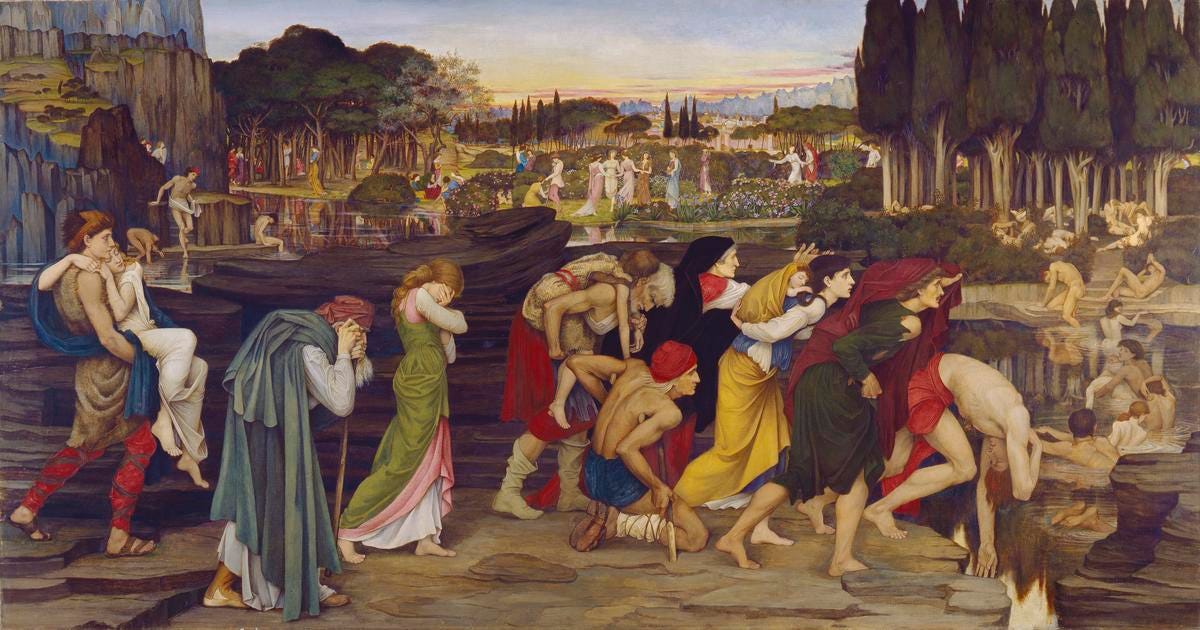
A bizarre forgetting stalks miserable humans. The depressed and suicidal, the anxious and traumatized, and yes — those who use social media a lot too. All have strangely selective memories, as if there’s been a fogging or erasure of the good times that came before. For severe cases, their past seems a uniform sea of melancholy, unbroken by joyful events, even if their pasts were happy.
Researchers call it Overgeneral Autobiographical Memory (OGM), or struggling to recall anything out of sync with the current emotional state1. A depressed person may forget laughing so hard they cried at a party, only remembering that they went and were bored or sad part of the time. PTSD sufferers “defensively blur” their past to avoid retriggering trauma, but end up “overblurring” and losing the ability to access good memories too.
Heavy social media users — who can recall fewer memories and have lower narrative coherence — remember their lives more as disconnected fragments than coherent stories2.
Short-form video platforms like YouTube Shorts and Instagram Reels reduce attention control, which in turn leads to poorer memory function3. Even a 10-minute break from life to use TikTok craters our ability to utilize prospective memory — remembering and executing an intended action in the future. Execution of planned tasks fell from 80% before the TikTok break to 49% after4.
Losing the past that made us what we are may be a tragedy, but more disturbing is what it does to our futures. Lacking a repertoire of past joys and accomplishments for context, people with PTSD often can’t articulate future goals or even imagine what good outcomes look like. They default to predicting, “things will probably be the same as they are now5.”
It’s like a mythological punishment in Hades: damned to unceasing rumination on the painful present, barred from recalling past joys, and therefore unable to imagine a future beyond suffering.
I try my best to spend my free time in an internet void these days, but years ago I noticed how all these elements — foggy thinking, fractured attention, bad memory, and a blah mood tended to go hand in hand with what the modern world force-feeds us. I didn’t like what it did to me, even though I found it alluring. It made me forget what I was and wanted to be.
Most of us are not depressed or tormented by past traumas, but we can run aground in a monotone fog of grey forgetting. When we’re fogged in like this, I suspect we’ve stepped away from being fully human and lost our hold on meaning. We live degraded lives. We lose the plot, or rather, we forget it.
But there is a way out of the morass, and it lies in memory.
Remembering as Medicine
Before we talk about what memory can do for ordinary people, let’s look at what it does for the truly desperate.
One of the most creative solutions to depression and PTSD ever attempted boils down to enhanced remembering. Researchers trained depressed patients (some suffering from a bout of depression, and others in remission) to do one of two things6. Either they practiced recalling self-affirming memories, or they used the ancient method of loci, i.e., a memory palace, to place dynamic images of those good memories in a remembered physical place. They then “walked” through this place in their minds and saw the memories unfold.
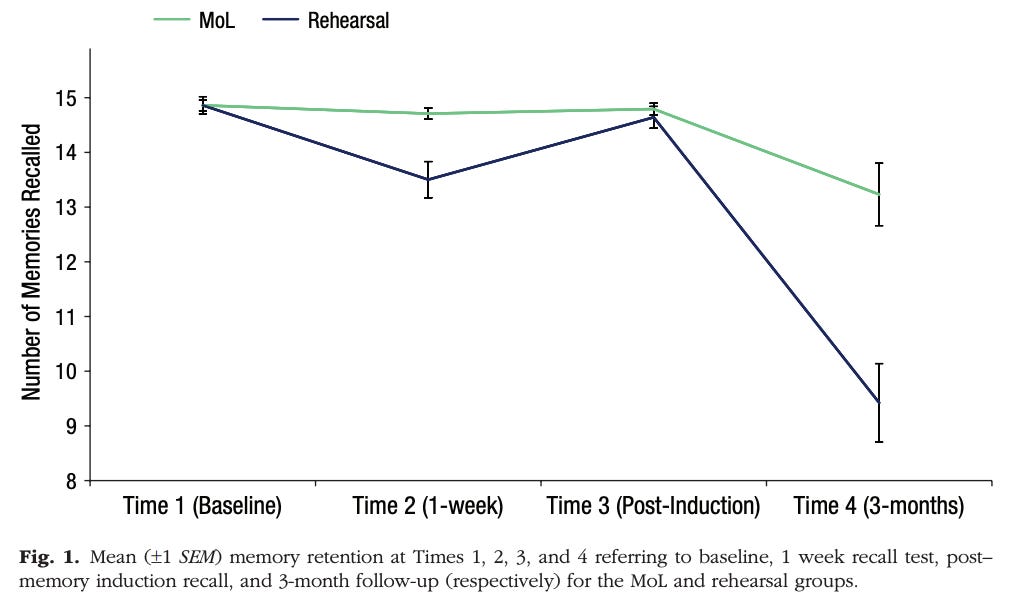
After a week of training straight memory rehearsal or walking the memory palaces, the groups improved the recall of self-affirming memories to near ceiling levels. Both reported fewer depressive episodes during their week of practice.
But during surprise follow-up tests conducted a week later, only the memory palace group maintained their recall, while the straight recall group lost a significant amount of theirs.
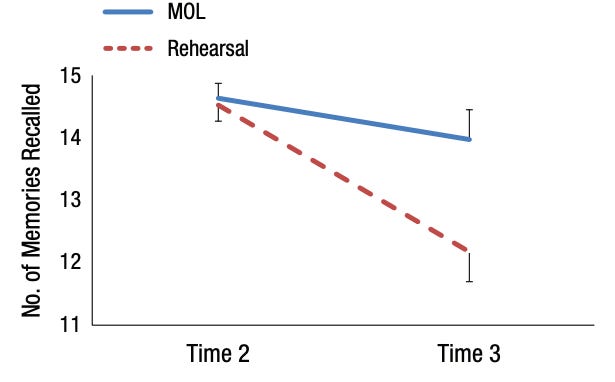
A follow-up study extended the results in two important ways7. The memory palace group showed superior recall 3-months after the study ended, despite discontinuing practice. And subjects learned to “repair” their mood by accessing the memory palace after they’d been experimentally made to feel sad. Doing this actually elevated their mood beyond baseline levels, something not observed in the memory rehearsal group. The patients’ memory palaces became repositories of “medicine” that could pull them out of a funk.
As part of a larger suite of exercises that “rescripted” traumatic memories, PTSD sufferers also benefited from building self-affirming memory palaces8. During PTSD episodes, subjects learned to mentally go to them and feel safe, which led to the episodes being less severe or petering out. By the end of the study, 65% of participants had improved enough that they no longer technically qualified as having PTSD.
Remembering Your Humanity
“Attention, taken to its highest degree, is the same thing as prayer. It presupposes faith and love. Absolutely unmixed attention is prayer. If we turn our mind toward the good, it is impossible that little by little the whole soul will not be attracted thereto in spite of itself.”
— Simone Weil, Attention and Will in Gravity and Grace
Memory palaces are not just a tool for the desperate. I suspect almost every human could lead a more meaningful, focused, and happy life by stocking one with what they find most valuable.
Religious people attend services and hear their liturgy — the good word — which reminds them of their aspirations and what’s truly important. It’s a counterweight to the world’s onslaught of distractions and lies. But many of us don’t attend religious services; we may not have much to ground us. Creating personal liturgies can be an effective way to more frequently be who we want to be and feel how we want to feel.
I’ve never put happy memories in a memory palace like the studies mentioned above, but I do add what I find true, good, beautiful, useful, and meaningful. The result is an attentional ideology, stitched together from dozens of thinkers and artists who’ve impacted me. Adding to it and reviewing it creates a virtuous cycle, and I think it centers around unbroken, reverent attention to what’s good.
When life seems blah and humdrum, it’s often because we’re not paying close enough attention to see where the magic is. We swipe from video to video, our eyes skim through the book, and we check out during conversations. Without attention on life, why wouldn’t life be dull? And when we forget something, it’s often more true that we never paid attention to it in the first place. We can’t remember what we barely see.
Slowing down and adding impactful things to a memory palace fixes a lot of this. We can’t memorize or review anything without focused attention on it, and when we focus we start to see what’s good about it. When we find these bits of reverential attention, it changes our headspace and jolts us out of ruts.
What should you memorize? Spiritual, philosophical, or scientific precepts, aphorisms, poems, speeches, snatches of dialogue — whatever has the ring of the true, the good, the beautiful, or the useful. We do have to be careful about what labels and ideologies we let into our identities. Pick the wrong ones and we can make ourselves fragile and stupid. But the upsides of bolstering smart beliefs with a curated memory palace are too good to pass up.
Last night I spent 5 minutes adding a quote from one of Cicero’s books to a broken light pole on Live Oak Street in Austin, which is part of a memory palace.
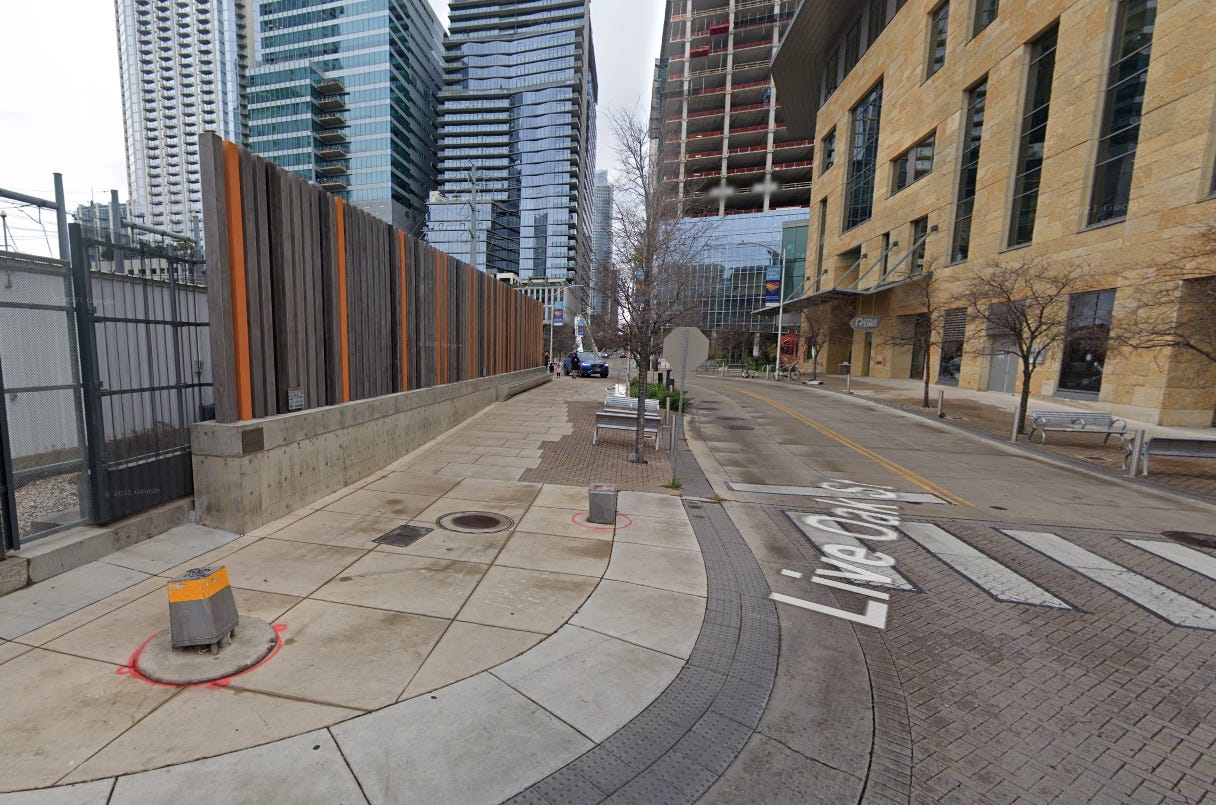
Omnia mea mecum porto — all that is mine I carry with me. The meaning is obscure if you haven’t read the book, but it’s philosophically important, and how I want to live. Each time I review it, I’ll be reminded of it, recontextualizing my present.
The Architecture of Us
Live in the now!
It’s the mantra of today’s wellness culture, and for good reason. Ruminating on the past or dreading the future is no way to live, and it taints this moment, which is the only time we’re guaranteed. By all means, meditate and live mindfully.
But living in the now without the context of meaningful “then” or higher ideas embedded in memory leaves us with a void and robs us of happiness. Building a memory palace isn’t just a fun cognitive trick for showing off, but part of reclaiming your life from the entropy built into the digital age.
Place a poem on the street corner or a cherished memory in your childhood bedroom and you’re decorating your internal world in a way that makes you more aspirational and reverentially you. You become harder to discourage, harder to distract, and better at remembering what’s important when times get tough.
Begin To Remember
If you’ve got some grey fog and meaninglessness you’d like to move beyond, my course Memorize for Meaning, goes deep into the mechanics of the Method of Loci, memory palaces, and other mnemonics designed for internalizing philosophy, poetry, and the beautiful truths that modern life often washes away.
Check it out:

Thanks for reading Socratic State of Mind.
If you liked this article, please like and share it, which helps more readers find my work.
Sumner JA, Griffith JW, Mineka S. Overgeneral autobiographical memory as a predictor of the course of depression: a meta-analysis. Behav Res Ther. 2010 Jul;48(7):614-25.
Nilsson, M. (2022). The Role of Excessive Social Media Usage in Autobiographical Memory [Master’s thesis, Lund University]. LUBSearch. https://lup.lub.lu.se/student-papers/record/9089905
Al-Leimon O, Pan W, Jaber A-R, Al-Leimon A, Jaber AR, Aljahalin M, Dardas LA. Reels to Remembrance: Attention Partially Mediates the Relationship Between Short-Form Video Addiction and Memory Function Among Youth. Healthcare. 2025; 13(3):252.
Chiossi, F., Welsch, R., & Mayer, S. 2025. Short-Form Videos Degrade Our Capacity to Retain Intentions: Effect of Context Switching On Prospective Memory. Proceedings of the CHI Conference on Human Factors in Computing Systems.
Kleim B, Graham B, Fihosy S, Stott R, Ehlers A. Reduced Specificity in Episodic Future Thinking in Posttraumatic Stress Disorder. Clin Psychol Sci. 2014 Mar;2(2):165-173.
Dalgleish, T., Navrady, L., Bird, E., Hill, E., Dunn, B. D., & Golden, A.-M. (2013). Method-of-loci as a mnemonic device to facilitate access to self-affirming personal memories for individuals with depression. Clinical Psychological Science, 1(2), 156–162.
Werner-Seidler, A., & Dalgleish, T. (2016). The Method of Loci Improves Longer-Term Retention of Self-Affirming Memories and Facilitates Access to Mood-Repairing Memories in Recurrent Depression. Clinical Psychological Science, 4(6), 1065-1072.
Clifford G, Meiser-Stedman R, Johnson RD, Hitchcock C, Dalgleish T. Developing an Emotion- and Memory-Processing Group Intervention for PTSD with complex features: a group case series with survivors of repeated interpersonal trauma. Eur J Psychotraumatol. 2018 Jul 30;9(1):1495980.
"A bizarre forgetting stalks miserable humans. The depressed and suicidal, the anxious and traumatized, and yes — those who use social media a lot too."
Its always 2 or more of these, and too much social media is always one of them. So many believe that their autopilot identity is their only true self. Its a bummer.
Andrew, this resonated strongly with some of the work I’ve been developing around cognition and environment.
Your description of memory loss in depression, trauma, and heavy digital use aligns with something I’ve been trying to formalise: memory is not just recall — it is how priors are given salience. It determines which thoughts arrive with weight, not just which thoughts are available.
In my model (TGTS — Thought Generation → Thought Selection), the mind is constantly presented with possible thoughts, but what gets selected is heavily biased by two things: the organism’s current physiological state (what I call the interostate) and the salience of prior experience. When memory becomes overgeneral or fragmented, that salience collapses, and the system defaults to whatever is dominant in the present moment — often low mood or threat.
That makes your point about the “tyranny of the present” very precise biologically.
Where your article adds something important is the idea that memory can be deliberately structured. The memory palace isn’t just a mnemonic device — it’s a way of curating priors. It’s effectively shaping the landscape from which future thoughts are selected.
From a developmental perspective, this raises a bigger question: if adults can rebuild this architecture intentionally, then childhood is where it is built implicitly. Story, play, ritual, gratitude, shared experience — these aren’t soft cultural add-ons. They are how a child accumulates the emotionally weighted priors that later allow them to regulate mood, imagine futures, and act with agency.
If useful, I’ve been writing about this more broadly in the context of how the environment shapes cognition (including the role of autonomic state and memory in thought selection). Your piece feels like an important adjacent articulation of the same problem from a different angle.